Learn how to create custom notifications for your (S)AEs to stay up to date.
⭐ (S)AE notifications are set up almost the same way as general notifications. This article only covers what's specific to (S)AEs. For the general setup, see: How do I create notifications within trigger events? (Step 5). |
Trigger 1: (S)AE actions
1. Choose the event
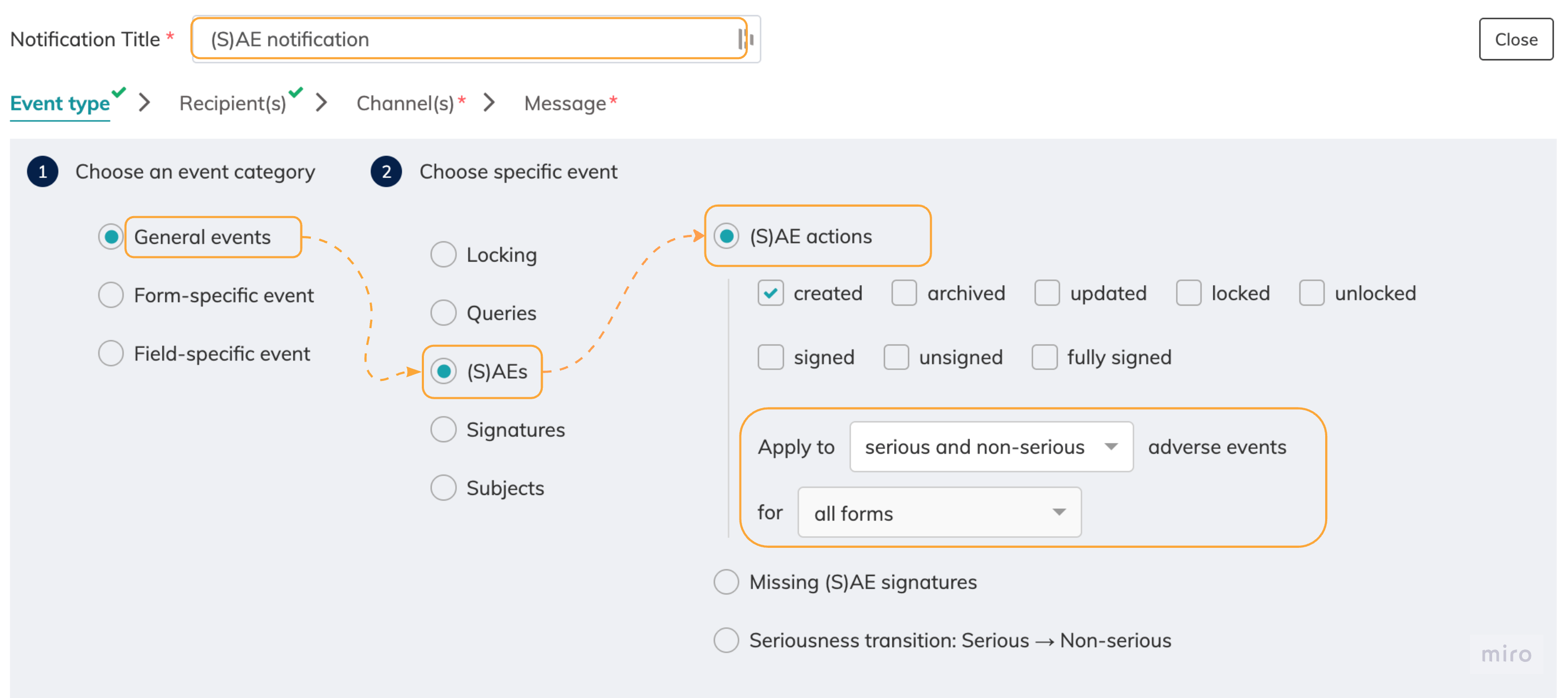
- In Step 5 (Trigger events), open the notifications and add a new notification.
- In the Event type tab, select General events → (S)AEs → (S)AE actions.
- Tick the action(s) for which the notification should be triggered.
- Under the trigger, set Apply to [serious / non-serious / serious and non-serious] adverse events for [forms], where you can select all forms or specific forms if multiple (S)AE forms have been configured and added to the workflow.
⭐ Created, archived and fully signed always refer to the whole (S)AE. Updated, (un-)signed, and (un-)locked can refer to specific (S)AE forms.
⭐ If forms are selected, the notification is only sent when the action happens on one of the selected forms and the (S)AE also matches the seriousness setting. Each selected form triggers the notification on its own.
2. Choose the recipient(s) & channel(s)
In step 2 and 3, select the roles (e.g. Safety) or collaborators who should get the notification, as for any other notification.
3. Write the message and add field tags
A) Message Configuration
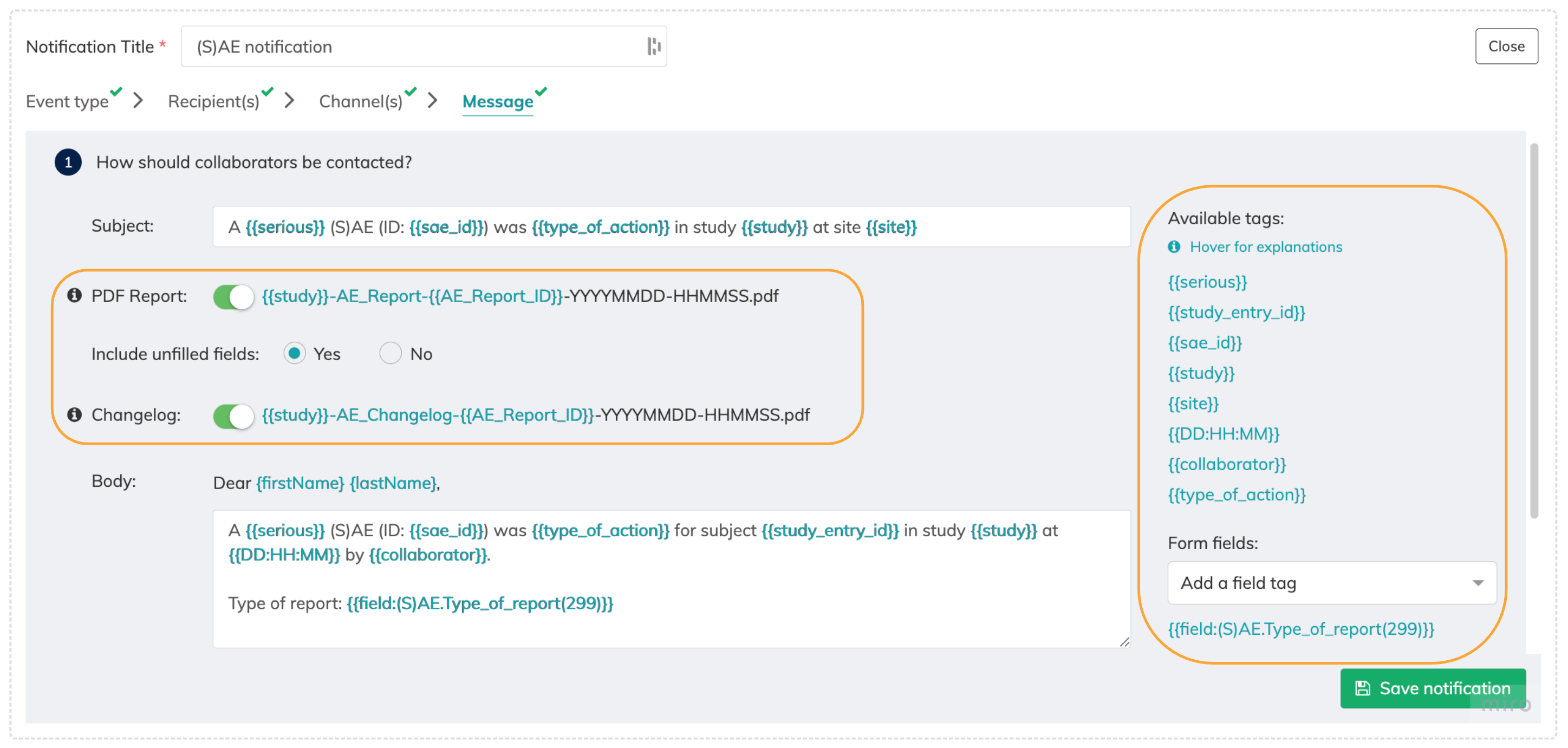
- Open the Message tab. Here you can configure the subject, message body and email attachments.
- You can edit the message using the Available tags. Hover over a tag to see its explanation, and click it to copy it. You can then paste it into the subject or body.
- The Form fields section lets you show the values of specific (S)AE form fields in the message. Click Add a field tag and search for the field, e.g. "Type of Report". You can choose fields from the forms selected in the Event type tab. If no form is selected, all (S)AE forms are available. A tag from a form that wasn't updated still shows its current value, if one exists. Table fields, repeating fields, matrix fields, rich text and file uploads aren't available.
- Selecting a field doesn't insert anything into the message. It adds a tag to the list below.
- Hover over the tag, click the copy icon, and paste the tag into the subject or body wherever the value should appear. You can use the same tag several times.
⚠️ If you remove a tag from the list, it stays in the message text but no longer gets a value. The recipient then sees the raw tag. Always delete the tag from the subject and body as well.
B) Email Attachments
PDF Report: Switch on PDF Report to attach a PDF export of the (S)AE, as it was when the notification was triggered.
- Include unfilled fields: choose Yes (default) to show all fields, or No to leave out fields without a value.
- Selected forms only: if you selected forms in the Event type tab, the PDF always contains all selected forms, even if the action only happened on one of them. If no form is selected, it contains the whole (S)AE/all forms.
Changelog: Switch on Changelog to attach a PDF of the (S)AE's audit trail. It contains all changes made since the last notification was triggered.
- The changelog always shows the actual changes and isn't limited to the selected forms.
⭐ PDF Report and Changelog are also available for the Seriousness transition (serious → non-serious) trigger.
Trigger 2: Missing (S)AE Signatures & Seriousness Transition
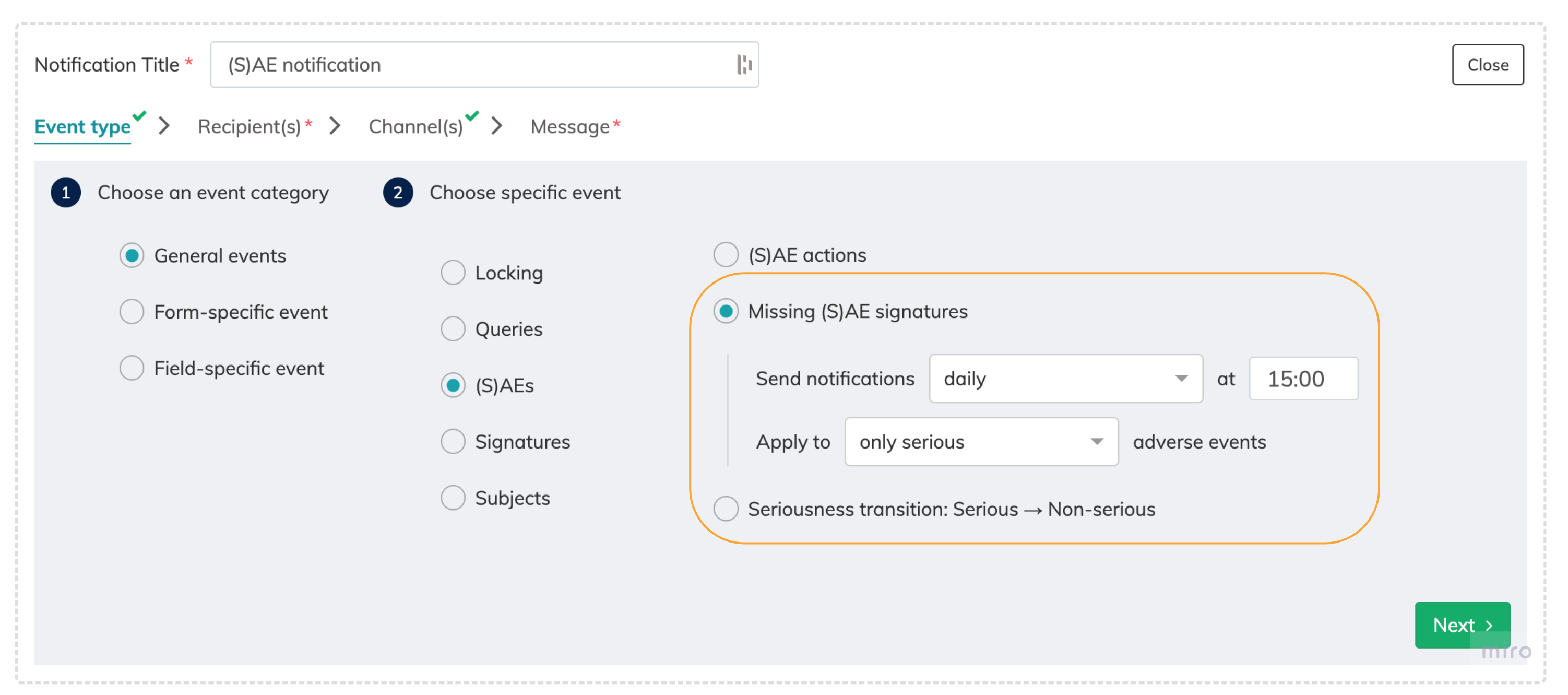
Missing (S)AE signatures: You can send recipients regular reminders about (S)AEs that are still missing signatures. Reminders can go out daily, weekly or every two weeks, at a time you choose. Each reminder lists every (S)AE form in the study that isn't fully signed yet.
Seriousness transition (serious → non-serious): This trigger sends a notification when an (S)AE that met the seriousness criteria is downgraded to non-serious.
✉️ Still have questions? Feel free to contact your Customer Success Manager or email us at support@climedo.de. |
Was this article helpful?
That’s Great!
Thank you for your feedback
Sorry! We couldn't be helpful
Thank you for your feedback
Feedback sent
We appreciate your effort and will try to fix the article